

Uncategorised
JPMorgan Publishes Long-Term Gold Forecast

Feb
JPMorgan has recently outlined a long-term gold price scenario suggesting that, under certain macroeconomic conditions, gold could approach $8,000 per ounce by 2028. The projection forms part of a broader research note examining central bank activity, interest rate expectations and global investment flows.
At the time of writing in early February 2026, gold has been trading around the $4,900–$5,000 per ounce range. JPMorgan’s estimate represents a forward-looking scenario rather than a guaranteed outcome. Like all price targets, it is based on economic assumptions that may evolve over time.
Forecasts of this nature are inherently speculative and subject to revision as market conditions change.
Key Drivers Referenced in the Forecast
JPMorgan’s research highlights several structural themes that may influence gold pricing over the medium term:
Central Bank Reserve Activity
Since 2022, central bank gold purchases have been elevated compared with longer-term historical averages. Reserve diversification strategies vary by country and may shift depending on currency policy, trade balances and geopolitical considerations.
While central bank demand can support pricing dynamics, it represents one of several interacting variables affecting gold markets.
Inflation and Real Interest Rates
Gold is often discussed in relation to inflation and real yields. When real interest rates are lower, some investors consider gold as part of a broader asset allocation approach. Conversely, sustained higher real yields can affect demand for non-income-producing assets.
Geopolitical and Economic Uncertainty
Periods of geopolitical tension or economic volatility can influence investor allocation decisions. Gold has historically experienced increased attention during such environments, although it has also gone through extended periods of price consolidation.
Currency Movements
The US dollar plays a significant role in gold pricing, as gold is typically denominated in dollars. Dollar strength or weakness can affect global purchasing patterns and investor sentiment.
Interpreting Long-Term Price Targets
A bank price target represents an analytical framework based on current assumptions about growth, inflation, policy and capital flows. Different institutions frequently publish differing projections, reflecting varying economic outlooks.
It is important to recognise that gold has experienced both multi-year advances and multi-year declines in the past. Past performance is not a reliable indicator of future results.
Market outcomes may differ materially from projections if inflation trends shift, monetary policy tightens unexpectedly, currency markets stabilise, or central bank demand moderates.
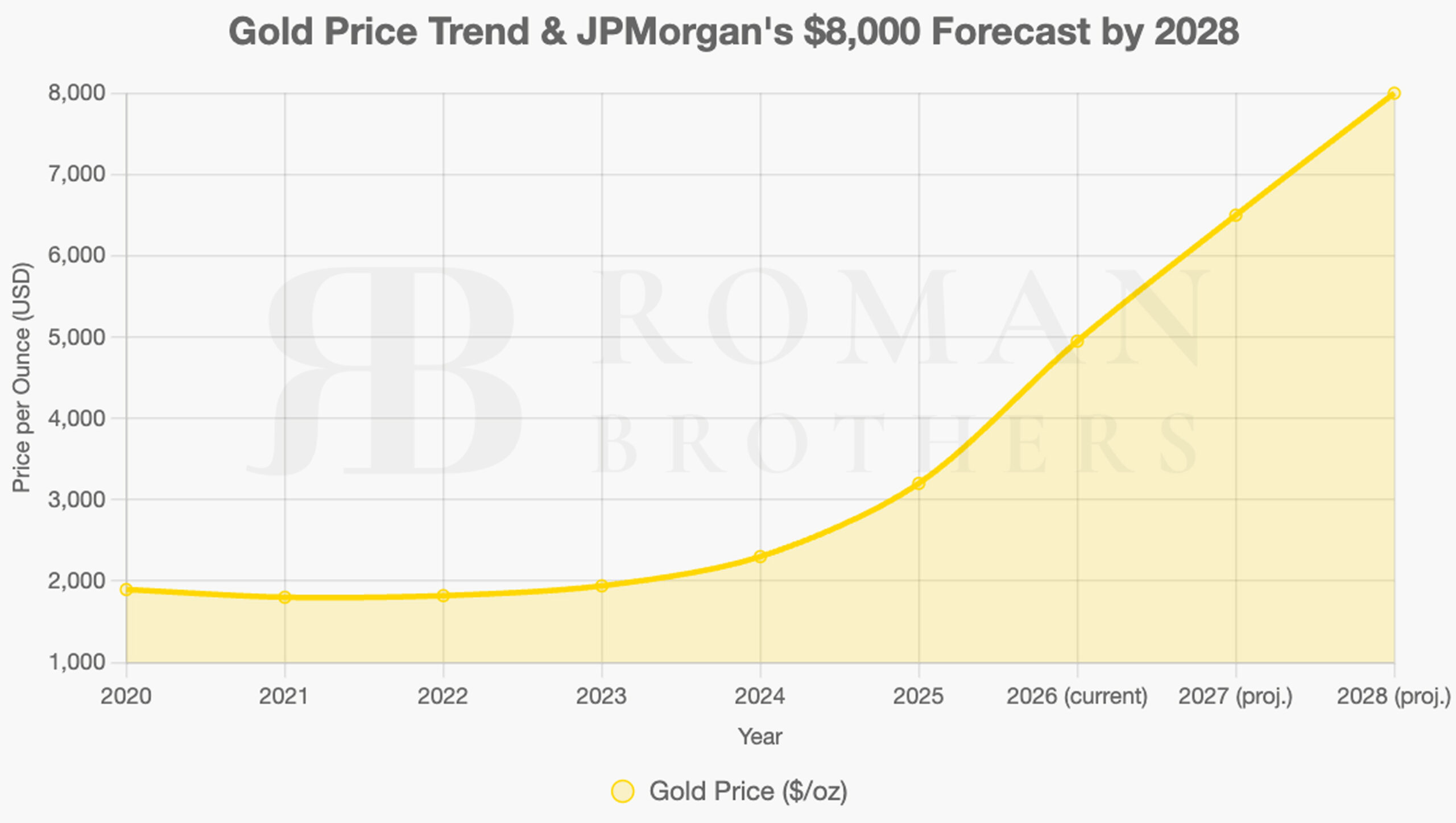
(Note: Historical prices are approximate annual averages/spot levels; 2026 is current as of February; 2027–2028 are illustrative based on JPMorgan’s trajectory to reach ~$8,000.)
Considering Gold in a Portfolio Context
Gold has historically been used by some investors as part of a diversified portfolio, particularly during periods of elevated inflation or financial market volatility. However, it does not produce income and can experience price fluctuations.
Certain UK legal tender coins are currently exempt from Capital Gains Tax for UK residents. Tax treatment depends on individual circumstances and may change.
Investors may wish to consider how physical gold fits within their overall asset allocation, risk tolerance and long-term objectives.
If you would like to discuss whether physical gold aligns with your broader financial objectives, you are welcome to contact Roman Brothers on 0208 080 2848 for further information.
The value of gold can rise as well as fall, and investors may receive less than they originally invested. Past performance is not a reliable indicator of future results. This communication is for information purposes only and does not constitute personal investment advice. Tax treatment depends on individual circumstances and may change.
