

Uncategorised
The Decline in Gold Discoveries & The Future of Long-Term Wealth

Apr
Why Gold Is Becoming More Valuable Than Ever in 2026
For centuries, gold has represented wealth, protection and stability. Across generations, families have turned to gold during periods of uncertainty, inflation and economic transition. In 2026, the conversation around gold has become even more relevant as global debt rises, mining production slows and investors begin reassessing where long-term value truly sits.
At the same time, finding new gold reserves has become increasingly difficult. Many of the world’s largest mining companies are facing growing challenges when it comes to discovering and extracting precious metals such as gold, copper and silver. With fewer major discoveries being made and extraction costs rising significantly, gold is becoming not only a luxury asset but a scarce one.
For investors looking beyond short-term trends, this shift is beginning to reshape the future of wealth preservation.
The Decline in Gold Discoveries
Over the past two decades, global gold discoveries have slowed dramatically. According to industry reports and mining analysts, the number of major new gold discoveries has fallen substantially compared to the early 2000s. Large-scale deposits are becoming increasingly rare, while the time and cost required to bring a mine into production continue to rise.
Mining companies are now forced to dig deeper into the earth, requiring more labour, energy, equipment, and infrastructure to locate economically viable reserves. Some mining projects can take over 10–20 years before production even begins.
Industry data from S&P Global and the World Gold Council has shown that major discoveries have become increasingly scarce in recent years, despite record investment into exploration.
Global Gold Discoveries Over The Past 10 Years
Over the last decade, major gold discoveries have continued to decline as mining companies face rising costs, deeper excavation requirements, and fewer economically viable reserves. Industry analysts have noted that large-scale discoveries are becoming increasingly rare, despite billions being invested into exploration globally.
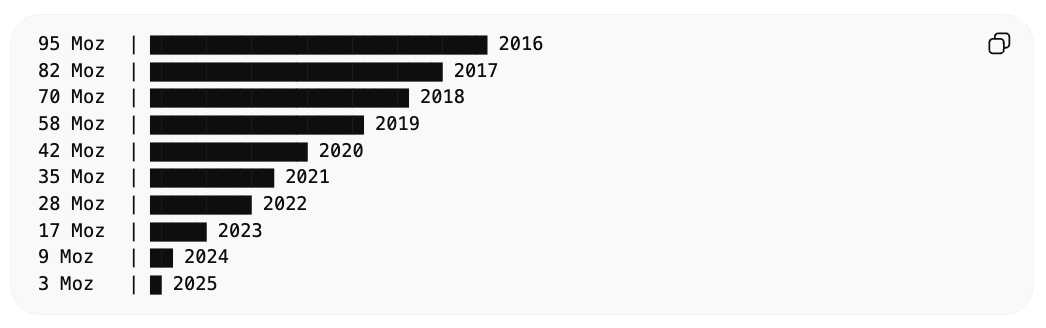
Industry estimates based on S&P Global Market Intelligence reports and global mining analysis.
Why Mining Has Become More Difficult
While gold still exists within the earth, much of the easier-to-access supply has already been mined. Many remaining deposits are located deeper underground, in remote environments or in regions requiring major infrastructure investment.
Mining operations today rely on advanced engineering, heavy machinery, chemical processing methods and large-scale logistical support to separate precious metals from ore. The deeper companies mine, the more expensive extraction becomes.
This challenge does not only affect gold. Copper and silver producers are also facing supply pressures as demand continues increasing across technology, infrastructure, and renewable energy sectors.
As global demand grows and natural supply becomes harder to access, investors are beginning to recognise the long-term value of physical assets with limited availability.
US Debt & Why Investors Are Watching Gold Closely
Another major factor influencing interest in gold is rising global debt particularly in the United States.
As governments continue increasing borrowing levels and printing currency to support economies, concerns around inflation and currency stability remain a key topic among investors. Historically, periods of economic uncertainty and high sovereign debt have often increased demand for hard assets such as gold.
In recent years, central banks themselves have significantly increased gold purchases as part of reserve diversification strategies. Many investors view gold as a form of financial protection during uncertain market conditions.
According to the World Gold Council, gold experienced strong performance throughout 2025 due to geopolitical uncertainty, inflation concerns, and investor demand for stability.
UK Tax Changes & Investor Behaviour
In the UK, changes to taxation and investment regulations have also influenced where individuals choose to place capital.
Higher property costs, changing mortgage conditions, increased regulation and taxation adjustments have caused some investors to reconsider traditional investment routes such as buy-to-let property.
While property continues to play an important role in long-term wealth strategies, some investors are increasingly exploring alternative assets including gold and precious metals as part of portfolio diversification.
Gold offers a different type of value proposition:
- A globally recognised asset
- Physical ownership
- Liquidity across international markets
- Long-term scarcity
- Generational transfer potential
Unlike property, gold can also be transferred, stored or divided more easily across generations.
Gold & Generational Wealth
One of the reasons gold has remained respected for thousands of years is its connection to legacy.
Families across cultures have historically passed gold down through generations as both financial protection and symbolic wealth. Unlike many trend-based assets, gold has consistently maintained global value over time.
For many investors, gold is not simply about short-term returns. It represents preservation, stability, and long-term thinking.
In ancient Egyptian culture, gold was referred to as “the tears of the gods” due to its rarity, beauty, and perceived spiritual significance. Across many cultures, gold has long been associated with prosperity, abundance and success.
Today, many people still view gold as more than an investment but as a timeless store of value.
Could Gold Become More Attractive Than Property Before 2029?
As we move through 2026 and beyond, some analysts believe precious metals may continue attracting attention due to ongoing economic uncertainty, global debt levels, inflation concerns and supply limitations.
This does not mean gold replaces property entirely. Instead, many investors are beginning to see gold as an additional layer of protection and diversification within a balanced portfolio.
With mining becoming more difficult, discoveries slowing and demand remaining strong globally, the long-term conversation around gold is likely only just beginning.
For investors focused on preservation, flexibility and long-term positioning, gold continues to hold a unique place in global wealth strategies.
Looking to Diversify Your Portfolio?
Gold has survived wars, recessions, currency collapses, and economic transitions for thousands of years. In a world driven by uncertainty and constant financial change, its rarity continues to give it value. As global uncertainty grows and precious metals become increasingly scarce, many investors are turning towards gold as a long-term store of value and generational wealth strategy.
Connect with Roman Brothers to explore investment opportunities, market insights and a more considered approach to precious metals.
Disclaimer: This article is intended for informational and educational purposes only and does not constitute financial or investment advice. Investors should always conduct independent research and seek professional guidance before making investment decisions.
